In Four Thousand Weeks: Time Management for Mortals, Oliver Burkeman doesn’t give us hacks or tricks to “get everything done.” Instead, he offers something more valuable and more uncomfortable. He reminds us that we’re finite. That the time we have is limited. And that learning to live well within those limits might be more important than trying to outsmart them.
We read this book together in the LIT Book Club, and it quickly became a favourite. Many of our members have found its insights helpful – not only for themselves, but in the way they support clients too. It’s a book that gets recommended again and again in conversations about burnout, boundaries, and how to make peace with not doing it all.
These are just a few of the lessons from Four Thousand Weeks that shape how we think about time and productivity as therapists, business owners, and human beings.
Why Four Thousand Weeks resonates with therapists
Burkeman writes from a place of deep honesty. He doesn’t pretend that there’s a perfect balance waiting just around the corner. Instead, he invites us to face the reality that we all have only so much time – about four thousand weeks, give or take – and that trying to control every moment or optimise every task often leaves us more anxious.
That perspective can feel especially relevant if:
- You’ve felt overwhelmed by the pressure to keep your practice growing
- You struggle with the tension between meaningful work and time scarcity
- You’ve burned out on productivity advice that promised more than it delivered
- You’re someone who helps others manage stress or transition, but still feel stuck in your own busyness
The lessons from Four Thousand Weeks meet many of us where we are: juggling care for others while feeling stretched thin ourselves.
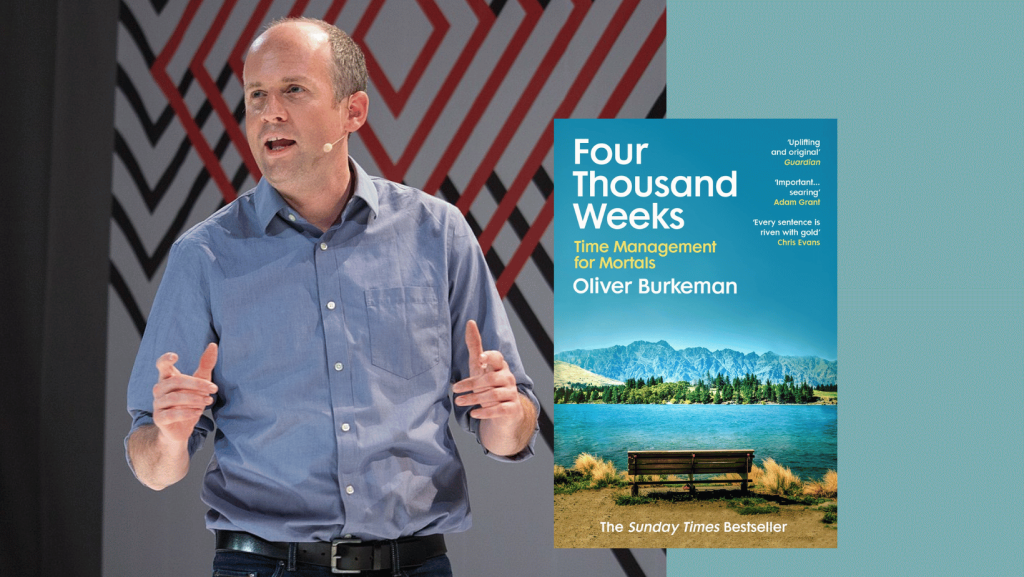
Lessons from Four Thousand Weeks
Rather than offering tools to help us do more, Four Thousand Weeks invites us to re-examine our relationship with time altogether. It challenges the assumption that productivity should be the ultimate goal and instead asks what it means to spend our time well – especially when we know we can’t do it all.
The lessons from Four Thousand Weeks have encouraged many of us to pause, question the pressure to be constantly efficient, and reconsider how we approach work, decision-making, and rest in our lives and businesses.
(Because although it may sound counter-intuitive, taking time off will help you be a better therapist and business owner.)
Below are some of the ideas that have continued to resonate within our community.
Letting Go of the Myth of Control
One of the central lessons from Four Thousand Weeks is that a lot of what we do in the name of time management is really about avoiding discomfort.
The discomfort of missing out.
The discomfort of uncertainty.
And of feeling like we are not in control.
Burkeman doesn’t tell us to stop planning. He simply invites us to look at what we’re trying to protect ourselves from.
As online therapists, coaches, and helping professionals, we often encounter this in the push to do more. One more offer. One more platform. One more project. All in the hope that one day, we’ll feel “on top of things.”
Burkeman’s reminder is quiet but powerful. We only have so much time. And we cannot spend it all trying to avoid the feeling of not having enough.
This is why we always encourage people to think very carefully about where their energy and time goes as therapists and business owners. It’s why we don’t recommend that you market your business on every platform or try to launch multiple offers at the same time.
Instead, start with one core offer and promote it in ways that will connect with your ideal client.
(Need more guidance on where to market your services? Read our blog on how to choose your marketing channels.)
Permission to Focus on What Matters
What makes Four Thousand Weeks so valuable is that it doesn’t just highlight what’s hard; it offers a different way of thinking about time altogether.
A way where doing fewer things can actually create more space.
Where saying no becomes an act of clarity, not failure.
Where we don’t associate our worth with how many hours we squeezed productivity out of, but to how honestly we showed up for what matters most.
That shift is especially meaningful if you want to build a business that reflects your values. When you let go of the fantasy of endless capacity, you can begin to make decisions that are more grounded and more sustainable.
These are the kinds of lessons from Four Thousand Weeks that continue to shape our conversations inside the LIT Community.
Using Four Thousand Weeks in Client Work
This book doesn’t just resonate personally. It also offers language and perspective that many of us have found helpful to bring into sessions with clients.
Whether you work with people navigating burnout, anxiety, perfectionism, or life transitions, the lessons from Four Thousand Weeks can offer a gentle shift in perspective.
You might find yourself drawing on it when clients are:
- Feeling overwhelmed by the pressure to be more productive
- Caught in unrealistic expectations about what they can get done in a day
- Struggling to prioritise what matters when everything feels urgent
- Trying to “fix” their time management in ways that keep leaving them exhausted
Sometimes, just naming that we are not supposed to be able to do everything can be incredibly relieving. Other times, clients benefit from unpacking the deeper discomfort underneath the need to optimise every hour.
You don’t need to assign the book or dive deep into the philosophy. Even small references – like the idea that saying no is part of choosing well, or that we can let go of the fantasy of total control – can open up thoughtful conversations about how your clients relate to time, urgency, and enoughness.
Gentle Prompts to Reflect On
Here are a few questions inspired by the book that might be worth journaling, discussing in supervision, or just sitting with for a while:
- What are you currently saying yes to out of habit, fear, or obligation (in your business or your personal life)?
- What would it mean to honour your time as finite and limited, rather than something to manage or maximise?
- Where might you be avoiding discomfort by overcommitting?
- If you accepted that you can’t do it all, what might become clearer or more possible?
- What would your business look like if you built it around these principles? Fewer tasks. Clearer priorities. More space for what matters. What would change?
These are not easy questions. But they are good ones. And they’re grounded in the kinds of lessons from Four Thousand Weeks that challenge us to slow down and choose differently.
Final Thoughts
Four Thousand Weeks doesn’t give us a magic solution. What it offers instead is something closer to truth. The reality that we have limited time, and that what we choose to do with it matters. Not because we can do everything, but because we can’t.
For those of us trying to run sustainable, values-based businesses as therapists, coaches, and helping professionals, this book offers a powerful lens through which to reassess our priorities. It reminds us that time is not a problem to be solved. It’s a reality to live within, with honesty and care.
If you’d like to keep exploring these kinds of questions with others who are doing this work too, we’d love to stay in touch.
Want more like this? Sign up for our newsletter to receive thoughtful content and reflections like these straight to your inbox.
Or join us inside the LIT Community where you can take part in our monthly book club and other events, enjoy discussions with therapists from around the world, and gain diverse insights into both the clinical and business side of running your own practice. Start your 1-week free trial here!